


Contents
At a panel it organised on 16 November as part of COP31 in Antalya, Ford Otosan addressed the decarbonisation of the automotive supply chain. The company stressed that expecting emission reductions from suppliers is not enough on its own, and that capabilities, purchasing terms, financing and public support need to be addressed together for transformation investments to materialise.
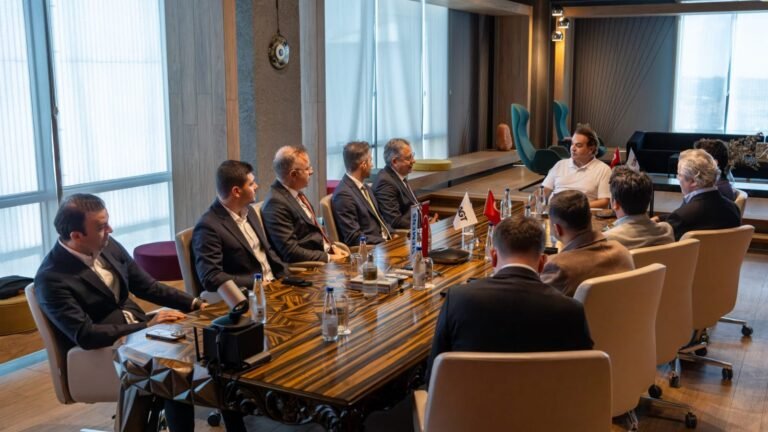
The panel, titled “Leading the Ecosystem: Scaling Decarbonisation in the Automotive Value Chain”, was held at the Koç Technology and Innovation Pavilion in the Green Zone. Alongside Ford Otosan General Manager Güven Özyurt, the session was attended by Umut Özdeş, General Manager of supplier Canel Otomotiv, Mauricio Colombari, Partner at PwC Brazil, Wagner Almeida of IFC and Valentina Di Sebastiano of the EU Delegation to Türkiye; it was moderated by Cankut Kaan Bolat, Senior Researcher at SEFiA.
Sustainability gaining weight in supplier assessment
According to Güven Özyurt, Ford Otosan has worked with its suppliers for many years on quality, cost, delivery and operational improvement; since 2022, the weight of sustainability in this relationship has increased significantly. The company manages this process through regular assessments, development roadmaps, a Supplier Sustainability Committee and follow-up work.
Ford Otosan regularly assesses its suppliers’ environmental, social and governance (ESG) performance to identify development needs, and provides training, awareness activities and technical guidance on environmental management, human rights, social responsibility and ethical business practices. Sustainability expectations are reflected in supplier relationships and purchasing agreements, while environmental performance, responsible sourcing practices and long-term development potential are monitored. Target areas are carbon emission reduction, energy and resource efficiency, circularity and responsible sourcing.
Noting that every supplier has a different starting point and different resources, Özyurt said they value progressing through long-term partnerships and joint roadmaps that take into account the technical capacity and resource needs of SMEs in particular. In his view, decarbonisation does not always start with a large investment; at some companies, accurate data, accurate measurement and reducing waste through resource efficiency can deliver meaningful results before major capital investments.
Expectations from suppliers and finance
With the contribution of Umut Özdeş, who brought the supplier perspective, the impact of public incentives on sustainability investments was discussed; the support suppliers need to meet the expectations of vehicle manufacturers was assessed through the contribution of the incentives used by Yeşilova Otomotiv to competitiveness and exports. Özdeş said that for all companies in the supply chain to take part in this process, small and medium-sized suppliers need access to affordable financing, incentives and technical support.
Wagner Almeida of IFC said reliable data, correct prioritisation and economically viable business models are decisive in making supplier projects ready for financing, and that standardised, accessible and performance-based financing solutions need to be developed for small-scale suppliers. Mauricio Colombari of PwC pointed out that the costs arise today while the gains appear in the medium and long term, and called for the economic losses of postponing the transformation to be taken into account as well. Valentina Di Sebastiano of the EU Delegation to Türkiye highlighted the importance of simplification efforts to reduce the reporting burden on small businesses.
A joint study with PwC on the way
Ford Otosan and PwC are preparing a white paper on the economic impact of the supply chain’s sustainability transformation. Focusing on investment costs, competitiveness and the financial dimension of the transformation, the study will be shared publicly by Ford Otosan in the coming period.
Ford Otosan, which has more than 25,000 employees in Türkiye and Romania, has an installed vehicle production capacity of 934,500 units; the capacity of its Kocaeli plants is 612,000 units.
Sources
- Ford Otosan, “Ford Otosan, COP31’de Tedarik Zincirinde Karbonsuzlaşmanın Yol Haritasını Paylaştı”, press release, 16 November 2026 (via Mese Public Relations) — fordotosan.com.tr
Image: Ford Otosan

Author