


Contents
Teledyne SP Devices, which specialises in high-speed data acquisition, has announced that a system built with its ADQ3 series digitizers and the libads disk streaming library reached a sustained write rate of 75 GB/s from six channels. According to the application note shared by the company, the system stored 4 TB of data in an uninterrupted recording lasting more than 50 seconds.
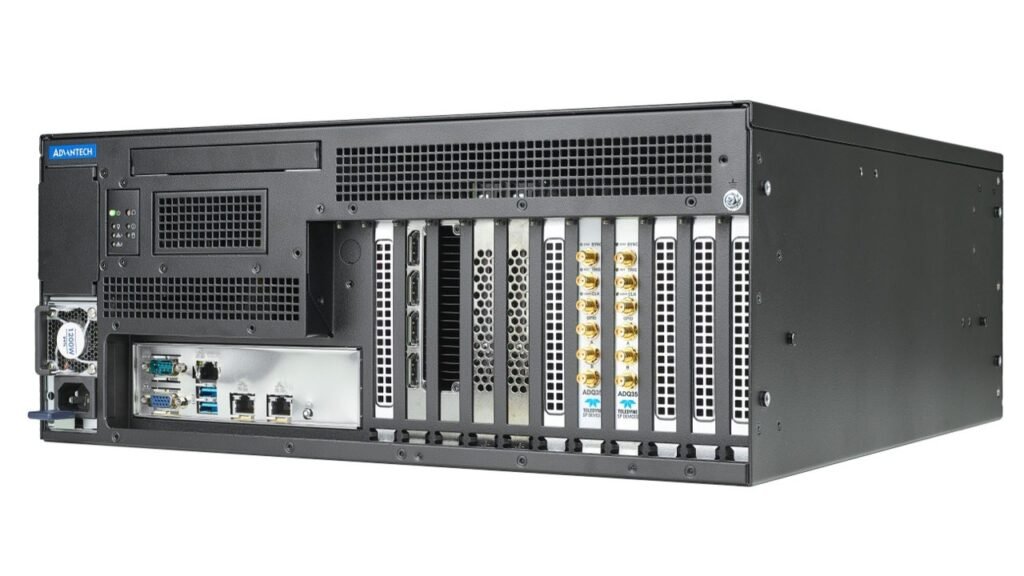
Six ADQ35 units on the DPS7-PCIe platform
The system was built on Teledyne SP Devices’ server-grade DPS7-PCIe platform in a 4U rack-mount/desktop format. The platform houses six ADQ35 digitizers, each acquiring data at a sampling rate of 10 GSPS (12.5 GB/s per channel). The same configuration can also operate as 12 channels at 5 GSPS. Clock generation, distribution and trigger synchronisation are built into the system: a 10 MHz reference generated by the company’s clock distribution card was distributed to all digitizers, and the trigger ports were daisy-chained with one digitizer acting as the master.
For storage, six 2 TB Kingston Fury Renegade G5 NVMe SSDs were used. The low-cost consumer-grade drives were configured in single-level cell (SLC) mode, reducing the effective capacity to 670 GB per drive while achieving write speeds of more than 12.5 GB/s per drive. Ubuntu 24.04 LTS was used as the operating system.
A disk streaming library that bypasses the file system
Developed for the ADQ3 series, the libads library writes data asynchronously to NVMe SSDs, bypassing the operating system’s file system and caching mechanisms. The CPU therefore handles only control and monitoring, while the high-bandwidth data path runs from the digitizer to DRAM buffers and from there to the disks. The library supports multiple digitizers per drive and multiple drives per digitizer (RAID), and optional NVIDIA GPUDirect Storage support enables real-time processing on the GPU before storage.
Test results
According to the results reported by the company, continuous recording from six channels ran for 53 seconds, and a total of 4,020 GB of data was written at 74.989 GB/s. The small deviation from 75 GB/s is due to the measurement also covering the time taken to start and close the recording. The recording was repeated several times and the data and metadata were verified. In additional tests with discrete records of 2,048 samples in 16-bit format, the highest sustained write rate for this configuration was measured at 75.9 GB/s.
Teledyne SP Devices notes that such systems are used in applications such as satellite monitoring and lidar, and that lower-cost setups can come in at 5–10 percent of the cost of enterprise solutions. The company also notes that it offers options scalable to petabyte-scale capacity and sustained write speeds above 80 GB/s with enterprise-grade NVMe drives, the 16-slot DPS16-PCIe expansion chassis, and PXIe, desktop and rack-mount form factors.
Source: Teledyne SP Devices, “75 GB/s Data Acquisition to Disk – A cost-optimized solution with ADQ35, leveraging libads”, press release, 3 November 2026.

Author