


Contents
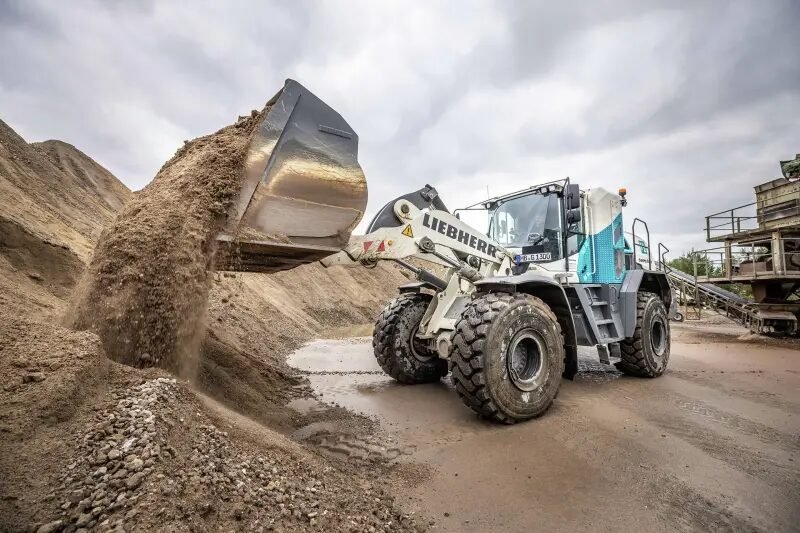
Liebherr has put its hydrogen-powered large wheel loader prototype, the L 566 H, into a field trial under real operating conditions at the fishing port in Bremerhaven, Germany. The multi-year pilot project, run jointly by Liebherr, Georg Grube GmbH and Green Fuels GmbH, aims to show that hydrogen can be a practical alternative for bulk material handling tasks previously carried out by conventionally powered loaders.
According to Liebherr’s announcement dated 6 November 2026, the L 566 H moves large quantities of material every day between crane systems, conveyor belts and silos at Georg Grube GmbH’s site. The prototype feeds conveyor systems, moves sand, gravel and rock between stockpiles and loads processed material onto trucks for dispatch.
A reliability test in a tight workflow
Large volumes of bulk material are handled, stored, processed and shipped at the port every day. The announcement stresses that workflows are tightly planned and that machines on site must always perform reliably to avoid downtime. Liebherr says these conditions give the prototype an opportunity to demonstrate that hydrogen works as an energy source for a large wheel loader.
Günther Holzer, Technical Managing Director of Liebherr-Werk Bischofshofen GmbH, says the company is working on various alternative drive systems and aims to bring the most suitable technology for each application into series production when the market demands it. According to Holzer, the Bremerhaven region has the infrastructure needed to refuel the hydrogen machine, which makes it possible to test the loader under real conditions.
Wolfgang Grube, owner and managing director of Georg Grube GmbH, says that rather than waiting for production-ready products, they wanted to contribute to the development process from the start, and that what matters to them is that the hydrogen loader does the same work as conventional machines with the same reliability, but with low emissions.
A regional value chain from wind to refuelling
The energy source for the pilot project is green hydrogen produced in the region. Electricity from wind turbines is converted into hydrogen in HY.City.Bremerhaven’s electrolyser; the hydrogen is transported using mobile storage solutions to a dedicated filling station commissioned at the Fraunhofer IWES Hydrogen Lab site in Bremerhaven. There, the loader can refuel quickly after a shift. Andreas Wellbrock, managing director of Green Fuels and initiator of the HY.City.Bremerhaven initiative, says the project shows how a regional value chain works in practice, from production to storage and transport, and on to refuelling and use in a heavy-duty machine.
The field test is being carried out as part of the H2B:IMPACT project, which Liebherr describes as Germany’s first “Hydrogen Valley”, funded by the EU and the Clean Hydrogen Partnership (CHP). According to the announcement, fuel cell cars, buses and trucks are already in use in the region; with the L 566 H, the scope of application extends beyond public roads.
Infrastructure is a prerequisite for commercialisation
Liebherr says the project is providing important data on the use of alternative drives in demanding applications and shows that, where suitable regional conditions exist, hydrogen propulsion could in future become an economically viable technology complementing battery-electric drives. Holzer stresses that for the market to grow, a network of hydrogen filling stations and more vehicles to ensure adequate utilisation of the infrastructure are needed, and that Europe must seize the opportunities offered by this technology to stay in the international competition.
The multi-year trial in Bremerhaven is intended to demonstrate that hydrogen can be a practical alternative to conventional drive systems, particularly in heavy-duty material handling applications.
Sources
- Liebherr, “Liebherr’s hydrogen-powered wheel loader begins trial operation in port handling”, press release, 6 November 2026: liebherr.com
Image: Liebherr

Author